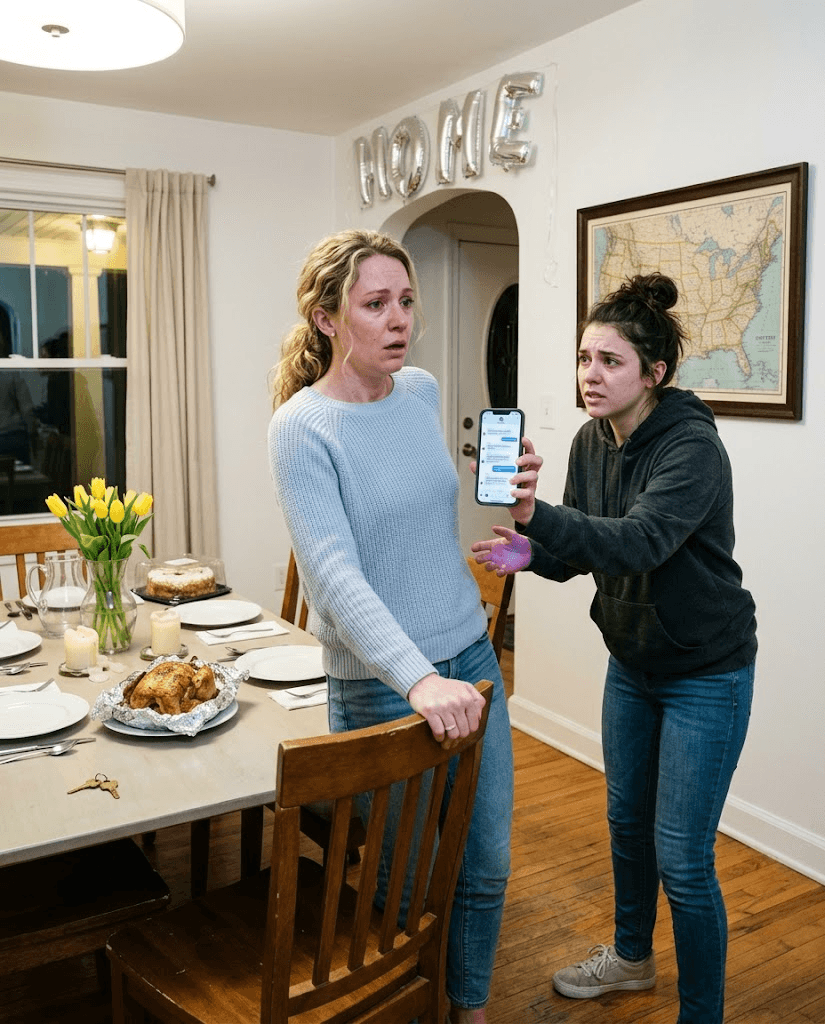

My name is Megan Turner, and the night my stepfather finally learned what I did for a living, he was holding my phone in his hand.
It happened at my mother’s birthday dinner in Richmond, Virginia.
She had booked a private room at an Italian restaurant with white tablecloths, low lights, and framed photographs along the walls.
The room smelled like garlic butter, lemon, warm bread, and the sharp cologne my stepfather always wore when he wanted people to notice he had money.
My mother, Diane, had invited everyone who mattered to her small circle.
My stepsister Chloe was there, taking pictures of the candles before my mother even sat down.
My uncle Ray was there, already asking if the restaurant had anything besides pasta.
Two cousins sat near the end of the table, whispering over the menu.
And then there was Martin Pierce.
Martin had been married to my mother for twelve years.
He came into my life when I was sixteen, which meant he met me at the exact age when a girl can be taught to disappear inside her own home.
He did not raise me.
He corrected me.
There is a difference.
He owned a chain of car dealerships, and he treated that as proof that he understood everything worth understanding.
He understood monthly sales.
He understood finance terms.
He understood how to make customers laugh while steering them toward a payment they had not planned to accept.
What he never understood was silence.
He thought silence meant agreement.
For years, when he made jokes about me being too serious, too stiff, too “Washington,” my mother would smile weakly and touch my wrist under the table.
That was her version of an apology.
A touch after the damage.
A soft look after the insult.
Never a sentence when it mattered.
I do not say that to be cruel to her.
I say it because families often confuse peace with quiet.
They are not the same thing.
By the time I was twenty-eight, Martin had built an entire version of me in his head.
In that version, I had moved to Washington to “answer emails for politicians.”
That was his phrase.
He used it at Thanksgiving.
He used it during Christmas phone calls.
He used it when neighbors asked my mother what I did.
“Our Megan answers emails for politicians,” he would say, smiling like he had made me smaller and more manageable for the room.
I could have corrected him.
I often wanted to.
But my work was not the kind of thing you explained over mashed potatoes.
I worked as a senior national security advisor on Senator William Holloway’s staff.
My weeks were built out of committee schedules, classified briefings, amendment language, risk memos, and calls that had to be answered whether I was eating dinner, sleeping, or standing in a grocery store aisle with a carton of eggs in my hand.
The job was not glamorous.
It was exhausting.
It was late nights under office lighting, coffee gone cold beside briefing books, and waking up to messages that made your stomach tighten before your eyes fully opened.
My mother knew I worked hard.
She did not know the details.
Martin did not want the details.
Details would have made it harder for him to laugh.
That night, I arrived at the restaurant at 7:08 p.m.
I remember the time because I had checked it in the parking lot before walking inside.
I had already answered three staff messages from the car.
There was a markup calendar update at 6:31 p.m.
There was a revised draft note at 6:44 p.m.
There was a text from our legislative director at 7:02 p.m. that simply said, “Keep your phone close tonight.”
That sentence sat in my chest the whole walk from the parking lot to the door.
Inside the private room, my mother hugged me tightly and said she was glad I came.
She was wearing a soft blue dress and the small gold earrings I had bought her for her fiftieth birthday.
For a moment, I let myself believe the night might be easy.
Then Martin looked at my phone in my hand and said, “Still on the clock, huh?”
I slid the phone into my blazer pocket.
“Something like that.”
He smiled at Chloe.
“She says that like she’s running the country.”
Chloe laughed because Chloe always laughed when Martin expected her to.
My mother looked down at the menu.
I sat near the end of the table.
That was where I usually sat at family dinners, close enough to count as present, far enough away that I could leave without making everyone stand.
Dinner moved the way those dinners always moved.
Martin talked about dealership numbers.
Uncle Ray talked about gas prices.
Chloe showed everyone pictures from a weekend trip.
My mother tried to keep the evening smooth, passing bread, refilling water, asking questions that did not invite conflict.
I answered when spoken to.
I smiled when necessary.
I checked my phone under the edge of the table twice.
At 7:32 p.m., an email came through with the subject line “Amendment Language – Urgent Review.”
At 7:39 p.m., a second email arrived with tracked changes attached.
At 7:43 p.m., our committee liaison texted, “Vote may move up.”
My pulse changed then.
Not dramatically.
Just enough that the restaurant noise seemed to pull away from me.
The waiter brought tiramisu with a candle in it because my mother insisted she did not want a cake.
Everyone sang softly.
Martin sang the loudest.
My mother closed her eyes to make a wish.
I remember hoping, foolishly, that maybe she wished for courage.
At 7:46 p.m., my phone buzzed.
The screen lit against my palm.
Senator Holloway.
I did not hesitate.
When the senator called directly after hours, it meant the situation had already passed through three layers of staff and landed on my desk because no one else could carry it.
I pushed my chair back.
“I need to take this.”
Martin’s eyes narrowed before he even knew who was calling.
“At your mother’s birthday dinner?”
“I’ll be two minutes.”
He leaned back in his chair and lifted his wineglass.
“You think you’re so important?”
There it was.
The old sentence in a new suit.
The room gave him exactly what he expected.
A few uncomfortable smiles.
One low chuckle from Uncle Ray.
My mother’s quick, nervous glance.
“Megan,” she whispered, “just sit down. Don’t make a scene.”
I looked at her for half a second.
That sentence hurt more than Martin’s.
He was trying to control me.
She was asking me to help him do it.
Family pressure has a special way of disguising itself as manners.
It tells the person being disrespected to be quieter so everyone else can stay comfortable.
The phone kept buzzing.
I answered.
“Megan Turner.”
Senator Holloway’s voice came through tight and fast.
“Megan, we have a problem with the amendment language. The committee vote moved up. I need you on this now.”
My body shifted automatically toward work.
I had one hand on the back of my chair.
I was already turning toward the hallway where I could hear him clearly.
Then Martin stood.
His chair scraped the floor hard enough to make my cousins look up.
He came around the table with that same dealership-floor confidence, the one that said every conversation belonged to him if he stepped into it loudly enough.
Before I could move away, he snatched the phone from my hand.
It happened so quickly that my fingers closed around empty air.
For a second, I just stared at him.
The shock was not that he had embarrassed me.
Martin had embarrassed me before.
The shock was that he had put his hand on the one thing in that room that was not family business, not dinner drama, not another one of his petty dominance games.
“Martin,” I said, “give it back.”
He raised it above his shoulder.
“No,” he snapped. “I’m going to teach you respect.”
The whole room went still.
Chloe’s phone camera lowered.
Uncle Ray’s fork stopped halfway to his mouth.
One cousin stared at the tablecloth like it might open and swallow her.
My mother looked at the candle flame instead of at me.
Even the waiter at the doorway froze with a coffee pot in his hand.
The silence was not empty.
It was crowded with choices nobody wanted to make.
Nobody moved.
Martin pressed my phone to his ear.
“Whoever this is,” he barked, “she’s at a family dinner.”
I saw the exact instant his confidence started to fail.
His mouth stayed hard, but his eyes changed.
The senator must have spoken, because Martin’s posture shifted by a fraction.
Then Senator Holloway’s voice came through the line, cold enough that even from where I stood, I could hear every word.
“This is Senator William Holloway. Why are you answering Megan Turner’s work phone?”
Martin’s face drained of color.
He looked at me as if I had hidden a weapon in plain sight.
“I’m her stepfather,” he said.
The senator did not react to the title.
“That is not what I asked.”
No one at the table breathed normally after that.
My mother’s hand moved to her throat.
Chloe set her phone facedown on the table.
The waiter quietly put the coffee pot on a sideboard and stepped back.
Martin swallowed.
For twelve years, I had watched him win rooms by talking over people.
I had watched him turn volume into authority and money into moral superiority.
But he could not sell his way out of that call.
He could not joke his way out of it.
He could not call me dramatic and make the senator disappear.
“Put Ms. Turner back on the line,” Senator Holloway said.
Martin lowered the phone an inch.
He did not give it to me.
Not yet.
That was when my Senate ID badge slipped halfway out of my blazer pocket.
It had been clipped inside because I had come straight from the train station.
The movement of reaching for the phone must have tugged it loose.
My mother saw it first.
Her eyes fell to the badge, then to my face.
The seal.
My name.
The credential stripe.
The version of my job she had allowed Martin to mock for years sat there in plain view between us.
“Megan,” she whispered.
It was not an apology.
Not yet.
But it was the first time all night that she said my name like she understood she had missed something important.
Martin saw the badge next.
His lips parted.
The old comeback did not arrive.
Senator Holloway spoke again.
“Now, Mr. Pierce.”
That was the first time Martin flinched.
He put the phone into my hand.
His fingers brushed mine when he released it, and I felt the tremor in them.
I took one step away from him.
Not backward.
Sideways.
Enough to make it clear that he no longer controlled the space between us.
“Senator,” I said, and my voice was steady in a way I did not fully feel, “I apologize for the interruption.”
“You do not need to apologize for someone else mishandling a secure work call,” he said.
The words landed in the room like a legal document.
Martin stared at the table.
My mother’s eyes filled.
I did not look at her for long.
I could not afford to.
Work came first because the situation actually was urgent.
The committee vote had moved up to the next morning.
The amendment language contained a phrasing issue that could have changed the scope of a reporting requirement.
It was not the kind of thing anyone at that dinner table would understand, and I did not need them to.
I needed them to understand one thing only.
My phone was not a toy.
My work was not a punchline.
And I was not sixteen anymore.
I stepped into the hallway and took the call.
For eleven minutes, I listened, answered, corrected language, and forwarded the marked draft to the legislative director.
At 7:59 p.m., I sent the revised note.
At 8:01 p.m., Senator Holloway said, “Good work. And Megan?”
“Yes, Senator.”
“Do not let anyone in your personal life make you careless with your professional authority.”
I looked back through the glass panel in the private-room door.
Martin was seated now.
He looked smaller than he had ten minutes earlier.
My mother was crying silently into a napkin.
Chloe was staring at her plate.
“I won’t,” I said.
When I returned to the room, no one spoke at first.
The candle had burned down into the tiramisu.
The coffee had gone untouched.
Martin cleared his throat.
It was the same sound he made before every fake apology he had ever offered me.
“Well,” he said, “I didn’t know it was that kind of call.”
I picked up my purse from the back of the chair.
“That’s because you never asked.”
My mother wiped her cheek.
“Megan, please don’t leave like this.”
I looked at her then.
Really looked at her.
For twelve years, I had been waiting for her to choose the truth over the temperature of the room.
That night, she was finally uncomfortable enough to notice the cost of staying neutral.
“I love you,” I told her. “But I’m done making myself smaller so dinner can stay pleasant.”
Her face crumpled.
Martin tried to recover one last inch of power.
“You’re being disrespectful.”
I turned to him.
“No, Martin. You mistook access for authority. That was your mistake.”
Nobody laughed.
Nobody backed him up.
That was the part I remember most.
Not the senator’s voice.
Not Martin’s face.
The quiet after he reached for support and found none.
I left the restaurant before dessert was cleared.
In the parking lot, the air felt cold against my face.
I sat in my car for almost five minutes before starting the engine.
My hands shook then, after everything was over, because bodies are strange that way.
They wait until you are safe to admit how hard they were fighting for you.
My mother called twice that night.
I did not answer.
She texted at 10:18 p.m.
“I am sorry. I should have stopped him.”
I read it three times.
Then I put the phone facedown.
An apology is not a time machine.
It cannot go back and stand up when someone needed standing up for.
But it can be a door, if the person is willing to walk through it.
The next morning, at 8:12 a.m., she called again.
This time, I answered.
She was crying before she said hello.
“I didn’t know,” she said.
“Yes, you did,” I told her gently. “You didn’t know my title. You knew how he treated me.”
That silence lasted a long time.
Then she said, “You’re right.”
Those two words did not fix twelve years.
But they were the first honest bricks of something new.
Martin did not call me.
For a man who loved speeches, he suddenly had nothing to say.
Three days later, my mother told me he had been furious in private.
Not because he felt guilty.
Because he had been embarrassed.
That mattered.
It told me what I needed to know.
He was not sorry he crossed the line.
He was sorry someone powerful had heard him do it.
My relationship with my mother did not heal overnight.
Stories like this rarely end that neatly.
We had long conversations.
Some were kind.
Some were painful.
I told her about the first time Martin mocked my scholarship letter.
I told her about the Christmas he said I only moved to Washington because I liked sounding important.
I told her about all the moments she touched my wrist after the insult, when what I needed was for her to speak during it.
She listened.
Sometimes she defended herself.
Sometimes she stopped and admitted she was defending the wrong thing.
That was progress.
A month later, I met her for coffee without Martin.
She looked tired, but clearer.
She asked me about my work.
Really asked.
For the first time, she let me explain as much as I was allowed to explain.
She did not interrupt.
She did not make it smaller.
When I finished, she said, “I’m proud of you.”
I believed her.
That surprised me.
As for Martin, he still owns his dealerships.
He still wears expensive jackets.
He probably still thinks respect means never being challenged.
But he has not touched my phone again.
He has not called my job a joke in front of me again.
And the next time my phone buzzed during a family meal, my mother was the one who said, “Go ahead, honey. Take it.”
It was a small sentence.
But small sentences can carry years.
The night began with Martin trying to teach me respect.
It ended with everyone in that room learning the difference between respect and control.
And for once, I did not have to raise my voice to prove I deserved the first and would no longer accept the second.