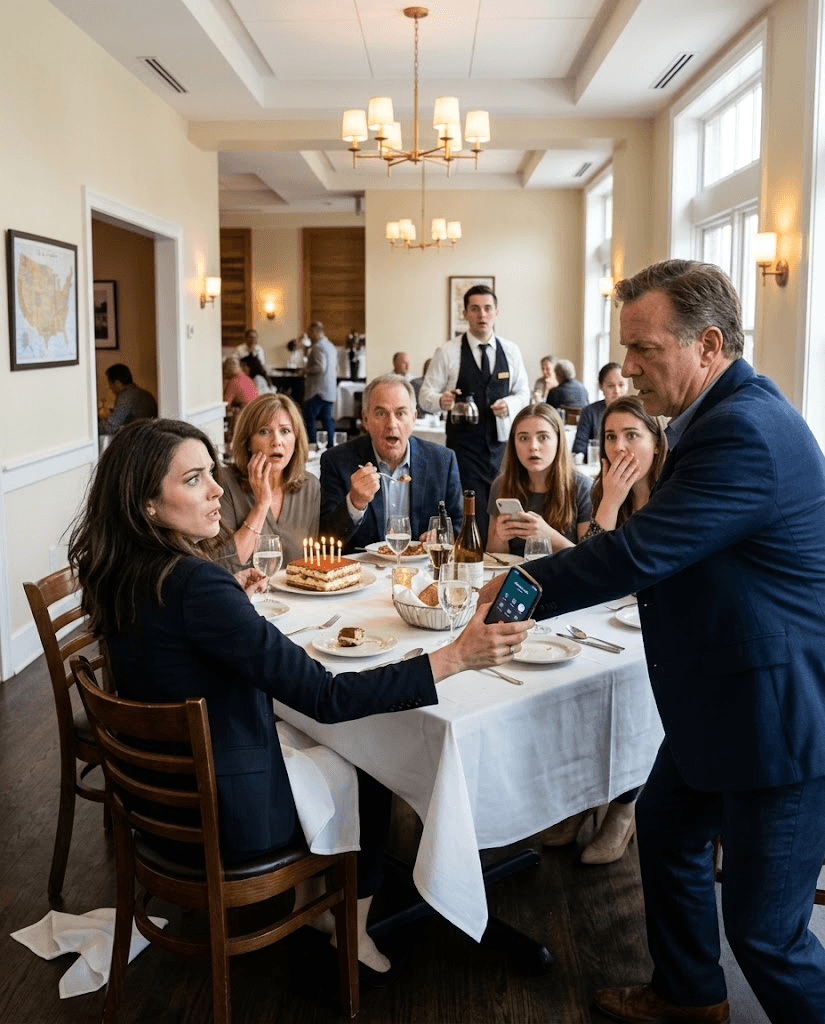

The sound did not belong in that room.
The Meridian Club was built for soft things: polished greetings, donor smiles, careful applause, forks against china, the low murmur of people pretending business and charity were the same kind of goodness.
Then my brother’s hand struck my daughter’s face.
It cracked through the hall so sharply that for half a second, nobody seemed to understand what they had heard.
My daughter, Maya, stood beside the podium with a blue ribbon twisted in both hands.
She was seven years old.
She did not fall.
Somehow that made it worse.
She just froze, eyes wide, hand hovering near her cheek like her body knew where the pain was but her mind refused to believe who had put it there.
The room smelled like burnt coffee from the refreshment table, lemon polish on the floor, and the expensive cologne my brother always wore when he needed strangers to think he was important.
Behind the registration table, a small American flag leaned in a chrome stand beside a pile of printed name tags.
I remember that flag because my brain grabbed onto anything ordinary to keep me from doing something that could never be undone.
A woman near the buffet lowered her paper coffee cup.
A man from the board looked down at his shoes.
Somebody’s fork hit a dessert plate with a tiny silver sound that seemed too delicate for what had just happened.
My brother Julian adjusted his cuffs.
That was the first thing he did after hitting my child.
Not apologize.
Not look around in horror.
Not realize there were witnesses.
He smoothed the sleeve of his jacket like Maya had inconvenienced the room by having a face where his hand had landed.
“Pathetic,” he said.
His voice carried because the microphone on the podium was still clipped near the front edge, pointed toward the exact place where Maya had been standing for the ribbon photo.
“Just like your mother. Both of you are defective. You can’t even hold a ribbon straight for the photo op. You’re embarrassing the brand.”
Maya blinked once.
Her mouth trembled.
She looked at me, but not the way children look when they want comfort.
She looked at me like she needed permission to believe the world had not just changed.
I wanted to cross the room and hit him back.
I wanted to grab the glass pitcher from the water station.
I wanted every person who had ever called Julian brilliant, disciplined, demanding, or complicated to see the simple word under all of that polish.
Cruel.
But I did not move toward him.
I moved toward my daughter.
That is the difference men like Julian never understand.
Rage wants a witness.
A child needs a wall.
I became the wall.
I stepped between Maya and my brother, then turned toward my father.
He was seated in the first row with his legs crossed, one hand resting on the silver head of his cane.
He looked almost pleased.
Not surprised.
Not embarrassed.
Pleased.
“Let it sink in, Elena,” he said.
His voice had that slow, polished weight he used when he wanted cruelty to sound like family wisdom.
“Tears are a luxury she can’t afford. Shame is the quickest way to build character. She needed that lesson.”
For a moment, I was eight again.
I was standing in his study with a spelling test in my hand and one red mark at the top.
I was thirteen, being told to stop crying because crying made people weak.
I was nineteen, hearing that my scholarship was not impressive because it was only a state school.
I was thirty-one, standing in a courthouse hallway after my divorce while my father told me, “Maybe if you had chosen better, you wouldn’t be starting over with a child and no cushion.”
Julian learned that language from him.
He learned that humiliation could be renamed discipline if you said it with enough confidence.
He learned that fear could be called respect.
He learned that silence from the room meant permission.
I had spent most of my life giving both of them that silence.
Maya would not inherit it from me.
The Meridian Foundation was Julian’s crown jewel, at least in public.
He posed for photos with school principals, shook hands with small business owners, and spoke about building character in underserved communities as if character were something he manufactured and donated.
Behind the scenes, I handled the details.
I managed the vendor invoices.
I fixed the seating chart.
I called the school office when the student choir was late.
I checked the donor list twice.
I printed the run sheet.
I ordered extra paper coffee cups when Julian decided at the last minute that the cheap ones looked embarrassing.
I was not on the stage.
I made sure the stage did not collapse.
That afternoon, at 2:17 p.m., I signed the audio checklist taped to the sound booth door.
The form was simple.
Lavalier one: podium.
Lavalier two: Julian.
Backup room mic: live for archive recording.
At 2:43 p.m., the event coordinator asked whether we really needed the archive recording.
“It’s just a ribbon photo,” she said.
I looked across the room at Julian, who was already telling a donor that every public moment needed to be documented.
“Yes,” I told her.
Julian loved proof when proof made him look generous.
He never imagined proof could turn around.
After my father said Maya needed humiliation, something in the room shifted.
Not enough.
Nobody shouted.
Nobody rushed Julian.
Nobody asked Maya if she was okay.
But the air changed.
People began to understand they were no longer just watching a family scene.
They were present for something recordable.
My eyes moved past Julian’s shoulder.
The sound booth sat behind a pane of glass tucked partly behind velvet curtains.
Inside, the sound tech stood with one hand near the mixer.
Above the small recording unit, a red light glowed.
Steady.
Unblinking.
Alive.
I knelt in front of Maya.
Her cheek was flushed where Julian’s hand had landed.
I did not touch the mark first because I did not want her to flinch from another adult hand.
Instead, I took the ribbon from her fingers.
Her skin felt damp and cold.
“You did nothing wrong,” I said.
She swallowed hard.
“Mom,” she whispered, “can we go home?”
Those words nearly broke me.
Not because she asked to leave.
Because she asked quietly, as if leaving required permission from the same people who had hurt her.
“Yes,” I said.
Julian gave a short laugh behind me.
“Oh, for God’s sake, Elena. Don’t make this dramatic.”
I stood slowly.
I looked at him.
Then I looked at the sound booth.
“Don’t touch anything,” I said.
My voice was quiet.
The microphone made sure it was not small.
The sound tech froze.
His fingers hovered inches above the stop button.
He looked from me to Julian, then to my father, then to Maya’s red cheek.
For the first time all afternoon, somebody made a choice that did not belong to Julian.
He took his hand away from the board.
Julian noticed.
His posture changed by one inch, maybe less.
But I knew him.
I knew the difference between confidence and calculation.
“Elena,” he said, lowering his voice into the tone he used with donors and difficult vendors, “you’re upset. We can handle this privately.”
Privately.
That word landed harder than the insult.
Privately meant no witnesses.
Privately meant no record.
Privately meant Maya would be asked what she had done to provoke him.
Privately meant I would be told I was emotional, unstable, bitter from my divorce, jealous of Julian’s success, difficult like always.
Privately was where families like mine buried the truth.
I turned toward the registration table.
The event coordinator stood there, pale and still, clutching her clipboard.
On the back of it, clipped beneath the schedule, was the yellow duplicate of the audio archive release.
I recognized my own signature at the bottom.
I also recognized Julian’s initials beside the line approving recording for promotional and internal review.
The coordinator followed my eyes and looked down.
Her face changed.
She understood before Julian did.
That paper did not save my daughter.
Nothing could undo the strike.
But it meant Julian could not pretend the room had imagined it.
It meant my father could not rewrite his cruelty into concern.
It meant every person who had stayed silent had a choice about what kind of silence came next.
Julian stepped toward the booth.
“Delete it,” he snapped.
The room inhaled.
The sound tech swallowed.
“No,” he said.
It was not a loud word.
It did not need to be.
A woman near the buffet covered her mouth with both hands.
One of the board members stepped back as if he needed distance from the decision he had made by standing still.
My father’s fingers tightened around his cane.
For the first time, his smirk cracked.
I took Maya’s hand.
Her fingers were tiny inside mine, and she was shaking so hard that the ribbon rustled against my wrist.
I wanted to pick her up, carry her out, and never look back.
But I also knew what happened when people like Julian controlled the first version of a story.
They turned witnesses into complications.
They turned victims into problems.
They turned mothers into hysterics.
So I did the one thing I had learned from years of cleaning up Julian’s messes.
I documented the room.
I looked at the coordinator.
“Please email me the archive file,” I said.
Julian barked out a laugh that did not reach his eyes.
“You’re not getting anything.”
The coordinator looked at him, then at the form, then at my daughter.
Her hands shook.
But she nodded.
My father rose halfway from his chair.
“Elena,” he warned.
There was the old voice.
The voice that had made me apologize when I had done nothing wrong.
The voice that had made me sit quietly through insults because pushing back was called disrespect.
The voice that expected me to shrink because I always had.
I turned to him.
“No,” I said.
He blinked.
Just once.
But I saw it.
The first small failure of a man who had mistaken fear for loyalty.
Then I looked at Julian.
“You hit my child,” I said.
He lifted his chin.
“She embarrassed the foundation.”
“She is seven.”
“She needs to learn how the world works.”
I looked around the room.
At the guests.
At the board members.
At the staff.
At every adult who had watched a child get struck and waited to see which way power would move before deciding what they believed.
“No,” I said. “She learned how this room works.”
Maya pressed closer to my side.
I put my arm around her shoulders.
Then I walked her toward the heavy oak doors.
Julian followed two steps.
“Walk out right now,” he said, “and you’re done here.”
I stopped with my hand on the door.
For a second, the whole room held still again.
A fork on a dessert plate.
A coffee cup gripped too tightly.
The tiny red light still glowing behind the glass.
I looked back at him.
“I was done the moment your hand touched her,” I said.
Then I opened the doors.
The hallway outside felt too bright.
There was a long runner over the tile, a brass table with a vase of white flowers, and the muffled sound of traffic beyond the front entrance.
Maya did not cry until we reached the elevator.
Then her face folded.
She made a sound I had never heard from her before, not loud, not dramatic, just small and broken.
I crouched and pulled her into me.
She wrapped both arms around my neck.
“Was I bad?” she whispered.
There are questions that split your life into before and after.
That was mine.
“No,” I said, holding her so tightly I could feel her heartbeat through her dress. “You were never bad. He was wrong. Grandpa was wrong. Every adult in that room who let it happen was wrong.”
She cried harder then.
I let her.
Tears are not a luxury.
They are proof the body still knows when it has been hurt.
By 4:08 p.m., we were in my SUV in the parking lot.
I had one arm around Maya while she sat sideways in her booster seat, and my phone sat on the center console buzzing so often the screen looked alive.
Three missed calls from Julian.
Two from my father.
One text from an unknown number.
It was the sound tech.
I have the file, the message said.
I stared at those five words until they blurred.
Then another message came in from the event coordinator.
I’m sorry. I should have stopped him.
I did not answer right away.
Not because I wanted to punish her.
Because my daughter was asleep against the seat belt, one hand still curled around the ruined ribbon, and for the first time that day, her breathing had evened out.
Care is not always a speech.
Sometimes it is not replying until your child is safely home.
Sometimes it is driving through traffic with one hand steady on the wheel while the other keeps checking the rearview mirror.
Sometimes it is making boxed macaroni because it is the only thing she will eat after a terrible day.
Sometimes it is photographing a red cheek under kitchen light because you hate that you need proof, but you know exactly what happens to mothers who show up without it.
At 5:31 p.m., I saved the audio file to three places.
My phone.
My laptop.
A cloud folder Julian did not know existed.
At 5:46 p.m., I wrote down everything I remembered.
The strike.
The words.
My father’s comment.
The witnesses.
The recording light.
The release form.
At 6:12 p.m., Julian called again.
This time, I answered.
He did not start with an apology.
People like Julian rarely do when they still think there is a way to win.
“You need to think carefully,” he said.
I was standing in my kitchen with Maya’s school backpack on one chair and her little sneakers by the door.
The normalness of those things made his voice sound even uglier.
“I have thought carefully,” I said.
“You release anything, and I will make sure every donor knows you staged this because you’re bitter.”
There it was.
The story he had already begun writing.
I looked at my daughter through the doorway.
She was on the couch in her pajamas, holding her stuffed rabbit under her chin, eyes fixed on a cartoon she was not really watching.
“You hit a child on a live microphone,” I said.
He went silent.
Just long enough.
Then he said, “Dad says you’re overreacting.”
I almost laughed.
Not because it was funny.
Because even then, even with the recording waiting in my inbox, Julian still reached for our father like a shield.
“Tell Dad he is on the recording too,” I said.
That was when Julian stopped breathing for a second.
I heard it.
A tiny absence.
A clean little pause where his whole world rearranged itself.
“Elena,” he said, and now his voice was different. “Let’s not destroy the family.”
I looked at the macaroni pot cooling on the stove.
I looked at Maya’s ribbon on the table.
I looked at the file name glowing on my laptop screen.
“The family?” I said. “No, Julian. You destroyed the part where I let you call this family.”
He said my name again.
I hung up.
The next morning, the board chair called me at 8:03 a.m.
His voice was careful.
Too careful.
He said the foundation needed to understand the context.
I sent him the audio.
No explanation.
No long email.
Just the file and the release form.
By noon, Julian’s assistant texted me that an emergency board meeting had been scheduled.
By 1:15 p.m., my father left me a voicemail calling me reckless.
By 1:22 p.m., he left another one asking whether Maya was “settled down.”
I saved both.
People reveal themselves when they think the first damage did not count.
They reveal themselves again when consequences arrive.
For two days, I did not post anything.
I did not call donors.
I did not leak the recording.
I took Maya to school.
I emailed her teacher.
I washed her blue dress by hand and cried over the sink where she could not see me.
I made pancakes on Saturday because she asked for them.
I slept on the floor beside her bed because she woke up twice asking if Uncle Julian knew where we lived.
That question became the sentence that moved me from anger into decision.
On Monday, I walked into the board meeting with a folder under my arm.
Not alone.
The event coordinator was already there.
So was the sound tech.
The board chair avoided my eyes.
Julian sat at the far end of the table looking like he had not slept.
My father sat beside him.
He had dressed for battle: navy suit, silver tie, cane angled against his knee.
“Elena,” he said, “before you embarrass yourself further, remember that emotional women often regret permanent decisions.”
I set the folder on the table.
Nobody spoke.
Inside were the audio release, the timestamped event checklist, my written account, the coordinator’s signed statement, and still images from the event photographer showing Julian’s raised hand and Maya’s face immediately after.
I had not asked the photographer for them.
She sent them herself.
Her note said, I kept seeing my own niece in that little girl.
That was the sentence that finally made me cry in the parking lot.
Not everyone in that room had been brave in the moment.
But some people found their courage afterward.
Late courage still matters when it is used to tell the truth.
The board chair cleared his throat.
Julian tried to speak first.
I raised one hand.
“No,” I said. “You had the room yesterday.”
Then the sound tech pressed play.
The audio filled the conference room.
The crack.
Maya’s silence.
Julian’s voice.
Pathetic.
Just like your mother.
Defective.
Embarrassing the brand.
Then my father.
She needed that lesson.
Nobody moved.
In front of me, Julian stared at the table.
My father’s jaw worked once, but no sound came out.
The board chair closed his eyes.
When the recording ended, the silence was different from the silence at the event.
That first silence had protected power.
This one exposed it.
Julian said, “It sounds worse without context.”
The coordinator made a small sound, half disbelief and half disgust.
The sound tech looked at him as if he had watched a man try to mop up rain.
I opened the folder and slid the photograph across the table.
Maya’s little hand was near her cheek.
Julian’s arm was still in motion.
My father was visible in the front row.
Smiling.
“Then explain the context,” I said.
Julian looked at the photograph.
For the first time in my life, my brother had no sentence ready.
My father tried.
“She was being dramatic,” he said.
The board chair looked at him.
“She is seven,” he replied.
It was not enough to erase what happened.
Nothing would ever be enough for that.
But hearing another adult say the obvious in a room where my father expected obedience felt like a door opening.
The foundation removed Julian from public duties that afternoon.
By the end of the week, he had resigned under pressure.
My father called it betrayal.
Julian called it a misunderstanding.
I called it the first honest thing that room had ever done.
Maya did not heal all at once.
Children do not work that way.
For a while, she flinched when men laughed too loudly.
She asked if she had to go to family events.
She kept the blue ribbon in her desk drawer, then one day threw it away without telling me.
I found it in the kitchen trash under a banana peel and a cereal box, and I left it there.
Some things deserve to be discarded without ceremony.
Months later, she stood in her school hallway beside a poster of the United States map and showed me a drawing she had made.
It was a picture of two people holding hands outside a house.
One was small.
One was tall.
The tall one had a giant square body like a wall.
“Is that me?” I asked.
She nodded.
“You’re blocking the bad stuff,” she said.
I had to turn my face toward the lockers for a second.
An entire room had taught her to wonder if she deserved it.
My job, for as long as it took, was to teach her that she never did.
I did not turn my brother’s world upside down because I wanted revenge.
I did it because his world had been built on everyone else staying quiet.
And the microphone was still live.