
What I remember first is the sound.
Not the shouting.
Not the slap of silverware against plates.
The sound that stayed with me was my father’s chair scraping across the hardwood, slow and heavy, like everyone in that dining room had already agreed to let him do whatever came next.
Thanksgiving had started bright enough to fool a child.
My mother’s candles were lit.
The turkey was perfect.
The house smelled like butter, cinnamon, and gravy, with my mother’s perfume sitting over all of it like a warning nobody wanted to name.
Tyler had worn his navy sweater because he wanted to look older.
He had stood in the hallway at home with his hands at his sides, trying not to grin while Megan fixed his hair.
“Do I look like a gentleman?” he asked.
Megan laughed so hard she dropped the comb.
“You look like you’re about to sell insurance,” she told him.
He did not know what that meant, but he liked the sound of it.
I should have taken them to a diner.
I should have made boxed stuffing in our own kitchen, let them eat pie on the couch, and ignored every guilt text from my mother.
But families like mine train you to mistake obedience for peace.
So I packed the green bean casserole, checked the front door twice, reminded Tyler not to run inside Grandma’s house, and drove across town while the late afternoon light sat low and gold on every windshield.
My parents lived in a clean suburban house with a small American flag near the front porch and a mailbox my father repainted every spring.
Everything outside always looked cared for.
That was part of the trick.
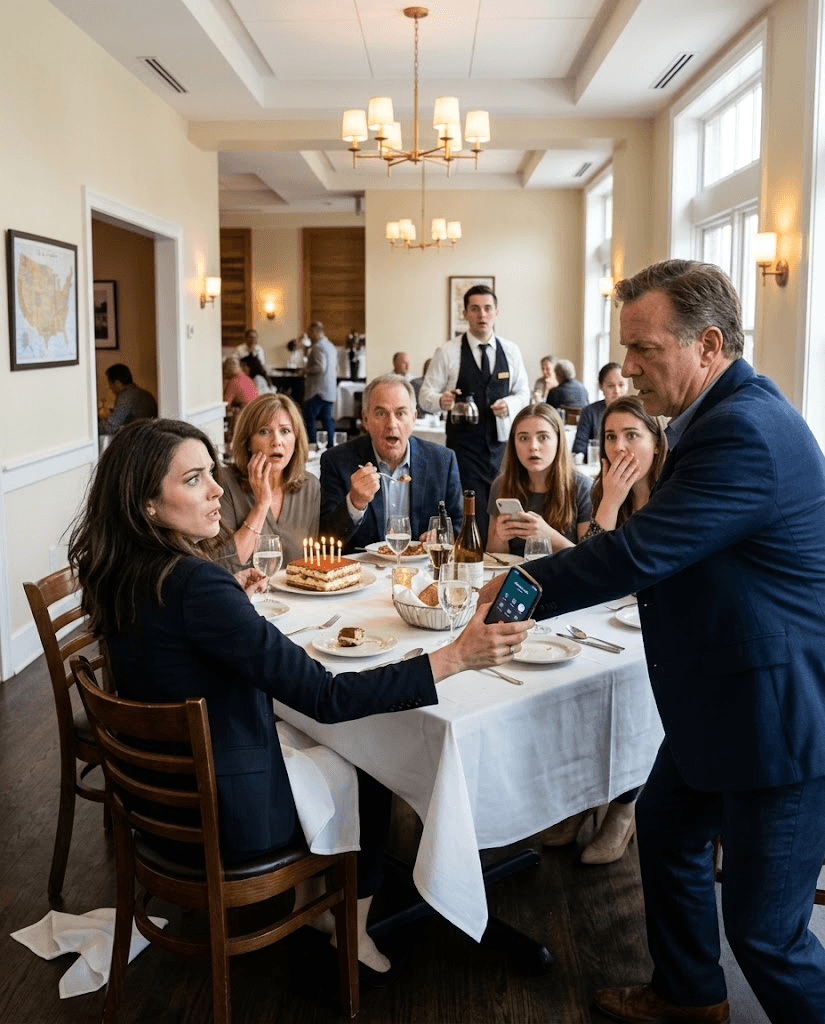
Inside, my mother had the dining room arranged like a magazine spread.
White tablecloth.
Crystal glasses.
Good china.
A centerpiece she would pretend not to care about while watching everyone notice it.
My sister Natalie arrived late, the way she always did when she wanted the room to tilt toward her.
She wore a cream dress, glossy heels, and the wounded expression she saved for money trouble.
“I almost didn’t make it,” she said, before even taking off her coat.
My mother touched her arm.
My father softened his voice.
Everyone made space for Natalie’s crisis before they even knew what it was.
I had watched that happen my entire life.
When Natalie forgot a deadline, someone had pressured her.
When Natalie overspent, she was anxious.
When Natalie quit a job, she was protecting her mental health.
When I worked through migraines, packed lunches at midnight, and paid my mortgage one exhausted month at a time, I was “making things harder than they needed to be.”
That was our family math.
Natalie’s problems were emergencies.
Mine were excuses.
Tyler sat beside me and tried to tell my father about his science project.
Richard cut him off halfway through the sentence.
“Natalie’s building has a new lobby, doesn’t it?” he asked, as if marble floors were more important than an eight-year-old explaining how volcanoes worked.
Tyler looked down at his plate.
Megan saw it and nudged a roll toward him.
That was my daughter.
She noticed hurt before adults in my family admitted it existed.
For the first hour, everyone performed Thanksgiving.
Uncle Warren made jokes.
Aunt Linda complained about her knee.
Uncle James and Aunt Susan smiled at whatever seemed safest.
Cousin Michael kept glancing at his phone, thumbs moving under the edge of the table.
Then my mother cleared her throat.
That sound had been controlling rooms since I was small.
“We need to discuss Natalie’s financial situation,” Elaine said.
My fork stopped halfway to my mouth.
Natalie looked down.
Not ashamed.
Prepared.
Richard set his beer down carefully.
“Your sister needs help with rent,” he said.
I waited for the part where someone named a realistic number.
“Five thousand a month,” he continued. “You’re going to cover it.”
The table went silent in that strange way family silence can feel rehearsed.
I looked at Natalie.
She did not look at me.
“I’m sorry?” I said.
“Don’t make me repeat myself,” my father answered.
My mother leaned forward.
“Natalie cannot be expected to move right now,” she said. “She is under tremendous stress.”
“She lives in a luxury apartment downtown,” I said. “If she can’t afford it, she needs to move.”
Natalie’s eyes filled.
I had seen her do it at twelve, at nineteen, at twenty-seven, and now at thirty-four.
The tears always came at exactly the point where accountability entered the room.
“You don’t care if I end up homeless,” she whispered.
“You could rent somewhere affordable tomorrow,” I said. “You just don’t want to.”
My mother’s mouth tightened.
“You have a house.”
“I have a mortgage.”
“You have stability.”
“I worked for it.”
“You have children,” Natalie snapped, as if that meant the world had been handing me gift cards and casseroles for ten years.
I thought of Tyler’s fever in February.
I thought of Megan’s cracked tooth.
I thought of the school office calling while I was on the clock, the copay receipt folded in my wallet, the grocery list I kept rewriting because prices never stayed where I needed them to stay.
Nobody had rescued me.
They had only judged how tired I looked while I kept going.
“I’m not paying your rent,” I said.
It was not loud.
That made it worse for them.
Some families can tolerate tears.
They can tolerate pleading.
They can even tolerate anger if it gives them something to punish.
What they cannot tolerate is a calm no.
My mother’s eyes sharpened.
“You will not embarrass this family by letting your sister struggle.”
“Her rent is more than my mortgage.”
“Then budget better.”
“I have two children.”
“And Natalie is my child,” Elaine snapped.
There it was.
The truth, finally plain enough for even my children to hear.
Megan’s face changed.
Tyler’s hand found the sleeve of my sweater under the table.
I looked at Natalie and said, “Move somewhere you can afford.”
Her tears vanished.
It was almost impressive.
“You always thought you were better than me,” she said. “Good grades, scholarships, your little house, your perfect responsible act.”
“I did earn what I have.”
My father’s fist hit the table.
The glasses jumped.
Forks hung in the air.
The candle flame bent sideways.
A spoonful of gravy slid off the serving spoon and marked the white tablecloth in a brown streak that my mother would have noticed on any other night.
Uncle Warren stared at his plate.
Aunt Linda stopped chewing.
Michael’s phone remained in his hand.
Nobody moved.
Richard stood.
His chair scraped back.
“Your mother asked you to help your sister.”
“No,” I said. “She demanded I pay for Natalie’s choices.”
His hand moved so fast my mind refused it at first.
Then his fingers closed around my throat.
My shoulder hit the wall.
The back of my head struck a framed family photo hard enough to rattle the glass.
For one second, the chandelier became nothing but yellow circles swimming above me.
My hands went to his wrist.
I could feel tendon and heat and the awful certainty of a man who had never had to hear no from anyone smaller than him.
“Useless daughter,” he hissed.
I heard Megan scream.
I heard my mother say, “Maybe now she’ll listen.”
I heard Natalie make a sound that was not fear.
It was satisfaction.
For one ugly heartbeat, I wanted to grab the crystal glass nearest my hand and smash the whole room open.
I wanted Richard to feel even a fraction of what he had made me feel.
Then Tyler’s chair scraped behind me.
“Let her go!” my son shouted.
My father released me.
I dropped, choking, and Tyler ran toward me with both arms out, brave in that heartbreaking way children are brave before they understand adults can be dangerous.
Richard turned toward him.
His foot came up.
The kick caught Tyler in the side and sent him down against the chair leg.
There are moments a mother remembers without language.
The body stores them first.
The sound of Tyler hitting the floor.
The flash of navy sweater.
The way his small mouth opened before any sound came out.
I crawled toward him before my breath had come back.
Megan moved too.
My mother slapped her across the face.
“Don’t you raise your voice in my house,” Elaine said.
My daughter froze with one hand against her cheek.
She looked more confused than hurt, and that broke something in me worse than the slap itself.
Because children can understand pain.
What they cannot understand is betrayal wearing a familiar face.
And then Uncle Warren laughed.
Not a full laugh.
A low one, the kind people use when they are trying to pretend cruelty is only an awkward moment.
Natalie pressed her napkin to her mouth.
Aunt Linda looked away.
Aunt Susan started to cry silently, but she did not stand.
Blood does not make people safe.
Sometimes it only gives cruel people a nicer word for access.
Michael’s phone slipped from his hand and landed screen-up on the floor.
The red dot was still blinking.
Recording Saved.
6:22 p.m.
The room saw it at the same time.
Richard’s face changed first.
Then Elaine’s.
Natalie whispered, “Delete it.”
Michael did not move.
For once, he looked like the boy I remembered from years before, the one who used to follow me around at summer cookouts asking if I would throw a football with him because the older cousins ignored him.
He had grown into a man who laughed at the wrong tables.
But in that moment, whatever he had become cracked.
“I didn’t mean to record all of it,” he said.
My voice came out broken.
“You recorded enough.”
Tyler made a small sound against my chest.
That sound ended the argument for me.
Not morally.
Practically.
I stopped trying to make them understand.
I stopped hoping for one decent adult to stand up.
I wrapped one arm around Tyler, reached for Megan with the other, and pushed myself to my feet.
Elaine stepped into my path.
“You are not leaving in the middle of Thanksgiving,” she said.
I looked at her.
Her lipstick was perfect.
Her dining room was ruined.
Her granddaughter had a red mark on her cheek, and she was worried about the schedule.
“Move,” I said.
My mother stared as if she had never heard my real voice before.
Maybe she had not.
Natalie started crying again.
“Now you’re making it about you,” she said.
I almost laughed.
Instead, I took my purse from the chair, grabbed my keys, and guided both children toward the hall.
Richard did not follow.
Men like him are brave in rooms where everyone is seated.
They are less brave when there is evidence on the floor.
Michael picked up his phone.
“I’ll send it,” he said.
“Do it now,” I told him.
His hands shook so badly he almost dropped it again.
The video arrived on my phone before I reached the front door.
Behind me, my mother said my name in the tone she used when she wanted obedience dressed up as respect.
I did not turn around.
Outside, the cold air hit my throat like a second hand.
The little American flag on the porch moved in the wind.
Across the street, someone’s garage light clicked on.
A dog barked once.
The world looked painfully ordinary.
That was the cruelest part.
I buckled Tyler into the back seat even though he kept saying he could do it himself.
Megan sat beside him, silent, one hand still near her cheek.
I drove three blocks before I pulled over because my hands were shaking too hard to keep the car steady.
“Mom?” Tyler whispered.
“I’m here.”
“Am I in trouble?”
I turned around so fast the seat belt cut against my chest.
“No. Never for protecting someone.”
Megan’s eyes filled.
“Grandma hit me.”
“I know.”
“She’s Grandma.”
“I know,” I said, and those two words carried more grief than anything else I had left.
At 7:04 p.m., we walked into an urgent care waiting room that smelled like disinfectant and old coffee.
The intake form asked for the reason for visit.
I wrote: Family assault at Thanksgiving dinner.
My hand shook only on the word family.
A nurse took Tyler back first.
Then Megan.
Then me.
They photographed the marks because that was procedure.
They wrote down our statements because that was procedure.
A police officer arrived at 8:11 p.m. and took the report in a small room with beige walls and a poster about domestic violence resources.
I gave him Michael’s video.
I gave him screenshots of the rent texts from my mother and Natalie.
I gave him the voicemail Richard left at 7:39 p.m., telling me I had “destroyed the family over money.”
People like my parents always call the truth destruction when it stops serving them.
By midnight, my phone had become a hallway full of ghosts.
Elaine texted first.
You need to calm down.
Then Natalie.
You always wanted everyone to hate me.
Then Aunt Linda.
Your father went too far, but holidays are stressful.
Uncle Warren sent nothing.
Aunt Susan sent one message at 12:18 a.m.
I am sorry I did not stand up.
I stared at that sentence for a long time.
Then I wrote back, You were there.
She did not answer.
The next morning, Michael sent the full video file again, plus three pictures he had taken of the room after we left.
The chair on its side.
The gravy stain.
The family photo tilted on the wall.
He wrote, I should have stopped him.
I believed him.
I also knew belief did not erase what my children had seen.
For two weeks, my mother tried every door.
She called my work.
She left a bag of leftovers on my porch like turkey could repair a throat.
She sent Megan a card with a glittery pumpkin on the front and no apology inside.
She sent Tyler twenty dollars.
I mailed it back.
Natalie sent one long message about how she was “in crisis” and how I had “chosen money over family.”
I read it once.
Then I blocked her.
The police report did not heal anything.
The urgent care papers did not heal anything.
The recording did not tuck my children into bed or make Tyler stop sleeping with his closet light on.
Evidence is not comfort.
It is only a fence around the truth so nobody can drag it somewhere else.
Healing looked smaller than people imagine.
It looked like Megan asking if she could skip Grandma’s birthday and me saying yes before she finished the sentence.
It looked like Tyler crying in the school pickup line because a boy shoved another kid and the sound scared him.
It looked like frozen pizza on paper plates because I did not have the strength to cook, and both children still saying thank you.
It looked like me sitting on the bathroom floor at 2:13 a.m., touching the bruise at my throat and realizing I had spent my whole life calling that house complicated because calling it dangerous felt disloyal.
A month later, Michael asked if he could bring over the serving dish I had left behind.
I told him to leave it on the porch.
He did.
With it, he left a note.
I laughed because I was scared of being the next target. That is not an excuse. I am sorry.
I kept the note for a while, not because it fixed anything, but because it was the first sentence from that side of the family that did not ask me to make their guilt easier to carry.
By spring, Tyler stopped asking if Grandpa was mad.
Megan stopped flinching when my phone rang.
I found a therapist who took our insurance after three calls, two intake forms, and one afternoon spent on hold during my lunch break.
That is what people do not understand about leaving a family like mine.
The dramatic part is loud.
The real work is paperwork, appointments, blocked numbers, changed holiday plans, and teaching your children that love is not supposed to require proof of endurance.
The following Thanksgiving, I did not go anywhere.
I roasted a small turkey in my own kitchen.
Megan made mashed potatoes with too much butter.
Tyler set the table and wore the same navy sweater because he said he wanted to “take it back.”
I had to turn away for a second when he said that.
Not because I was sad.
Because he was eight, and he already understood something some adults never learn.
A thing can be touched by fear and still belong to you.
We ate at our little table with mismatched plates.
No crystal.
No white tablecloth.
No one demanding rent money over the sweet potatoes.
After dinner, we took slices of pie to the front porch and watched cars move slowly down the street under the orange streetlights.
Our house was not fancy.
The mortgage still came due.
The grocery budget was still tight.
The laundry still waited.
But Tyler laughed when Megan got whipped cream on her nose, and Megan leaned against my shoulder without checking who might be angry about it.
That was when I finally understood what I had missed for years.
Safety is not the absence of problems.
Safety is the absence of people who turn your problems into weapons.
The house was warm.
The candles were bright.
The room had once been full of people who knew our names.
None of that made us safe.
This did.
A small table.
Two children breathing easy.
A locked door.
And no one in the room who believed cruelty became love just because blood said so.