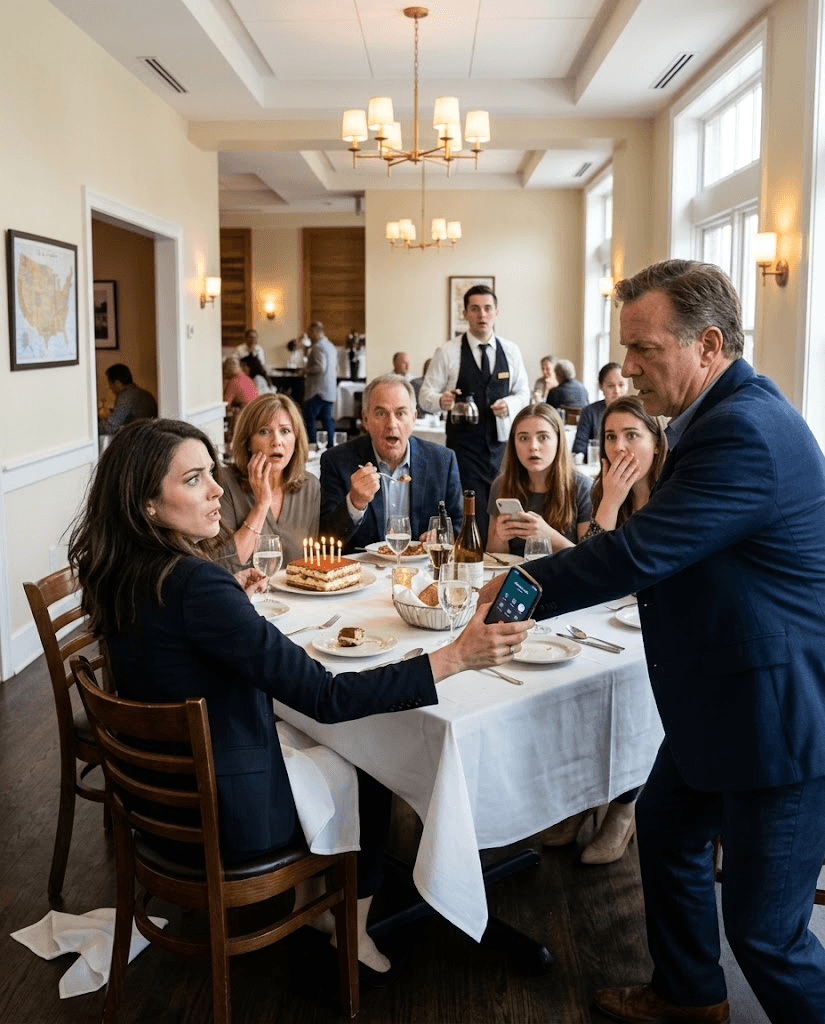

When my father entered the bedroom, I thought I still had one last lie left in me.
I thought I could sit up straight, wipe my face, and tell him I was fine.
That was what I had been trained to do for eight months.
Smile through dinner.
Lower my voice when Celeste Vale lifted hers.
Apologize when Adrian squeezed my wrist too hard under the table.
Pretend a beautiful house meant I was safe inside it.
But the second my father stepped into that room, the lie died before it reached my mouth.
He did not look at my eyes first.
He looked at my throat.
His face changed in a way I had never seen before, not even when I was sixteen and he caught a grown man following me through a parking lot after a late shift at the diner where I worked weekends.
This was worse.
This was quieter.
The purple handprint was already rising around my neck, ugly and undeniable, one finger-shaped mark curving toward my collarbone.
I saw him take it in.
Then he saw my split lip.
Then the faint smear of blood on the sleeve of my maternity dress.
Then he looked past me and saw Adrian standing beside his mother in the bedroom of the house my father had bought for us as a wedding gift.
Adrian had not even loosened his tie.
That was the part that made me feel sickest.
He looked composed, almost bored, as if the worst thing that had happened that night was an argument that had gone inconveniently loud.
His mother, Celeste, stood near the dresser with her arms folded, her diamonds catching the chandelier light.
She had always loved that chandelier.
She said it gave the room “lineage,” though there was nothing old or noble about the way she spoke to me under it.
“Dad,” I tried to say.
It came out broken.
My father stepped fully into the room, and the air changed around him.
He was not a tall man in the dramatic way people imagine power, but there was something about him that made people remember their manners.
He had flown home from Singapore that morning.
Three unanswered calls from me had not brought him.
The fourth call, the one I did not make because Adrian was in the hallway, had not brought him.
What brought him was one text message sent with shaking fingers from the guest bathroom while Celeste stood outside the door and said I was embarrassing the family.
Please come.
Two words.
My father had read them and boarded the first flight he could.
Now he was standing in my bedroom, staring at the marks on my skin.
“You touched my daughter?” he asked.
It was not loud.
That made it worse.
Adrian lifted both hands, the picture of innocence.
“She’s unstable,” he said. “You know how pregnancy can make women emotional. She fell.”
I watched my father’s jaw tighten.
Celeste made a small sound through her nose.
It was not quite a laugh, but it had the same cruelty in it.
“She ruined our family first,” she said.
My father turned toward her.
“What did you say?”
Celeste lifted her chin.
I had seen that chin lift a hundred times.
She did it when the caterer brought the wrong wine to Christmas dinner.
She did it when a housekeeper left a water glass on the piano.
She did it the first time I wore a cotton dress to her Sunday brunch and she told me, in front of twelve people, that “some girls never learn the difference between simple and cheap.”
“She came here with nothing,” Celeste said. “We gave her the Vale name. We gave her comfort. We gave her a life she never could have had alone. Then she decided to steal my grandson.”
“My baby,” I whispered.
Celeste smiled.
“A Vale baby.”
The room tilted a little.
I put my hand over my stomach and felt my son shift, small and alive under my palm.
No one had ever used him as a person in that house.
Not Adrian.
Not Celeste.
To them, he was an heir.
A surname.
A future chair at a table where I was already being erased.
Eight months earlier, when I married Adrian, people said I was lucky.
They said the Vale family was solid.
Established.
Comfortable.
The kind of family where every holiday photo looked polished, every couch looked expensive, and every apology came wrapped in a gift box instead of spoken out loud.
Adrian was charming then.
He opened doors.
He remembered how I took my coffee.
He called my father “sir” without sounding fake.
He told me he loved that I still worked, still drove my old car, still called my dad when I was upset because loyalty mattered to him.
I believed him.
That is the humiliating part, how badly you can want kindness to be real.
After the wedding, Celeste started small.
She corrected the way I held my fork.
She asked why I used drugstore lotion when “skin is a woman’s first résumé.”
She took a casserole I had made for a family dinner and set it aside, untouched, then ordered food from a restaurant and told everyone she had “rescued the evening.”
Adrian laughed.
Not loudly.
Just enough to tell me where I stood.
When I cried in the laundry room afterward, he found me sitting on the dryer with a dish towel in my hand.
“Mara,” he said, tired already. “You’re too sensitive.”
That became the sentence that followed me through the marriage.
When Celeste asked if pregnancy had made my face “puffy already,” I was too sensitive.
When she told Adrian not to let me decorate the nursery because I would make it look like a clearance aisle, I was too sensitive.
When she took the first ultrasound photo from my purse and framed it in her hallway before I had even shown my father, I was too sensitive.
When she corrected me every time I said “my baby,” I was too sensitive.
“Our baby,” she would say.
Then, later, when she thought I was too tired to fight, “the Vale baby.”
Adrian stopped sleeping on my side of the bed after the fifth month.
He said I kicked too much.
He said I complained about my back too much.
He said I had changed.
What he meant was that I had started saying no.
No, Celeste could not choose the doctor.
No, I did not want a night nurse selected before the baby was born.
No, I would not move into the downstairs guest room because Celeste thought stairs were “unbecoming” for a pregnant woman.
No, I would not hand over my medical passwords.
That last no changed everything.
Two weeks before my father came home, I went looking for a phone charger in Adrian’s study.
I had never liked that room.
It smelled like leather, coffee, and the cedar boxes Celeste bought him every birthday.
On the desk, under a stack of property folders, I found a file with my name on it.
At first I thought it was insurance.
Then I saw the words “mental instability.”
My hands went cold.
The petition was typed in neat paragraphs, each one uglier than the last.
It said I was erratic.
It said I was dependent on pills.
It said I had shown “episodes of aggression” during pregnancy.
It said Adrian had concerns for the unborn child’s safety.
There was a list of medications attached, but I had never taken them.
There was a statement from someone I had never met.
There was a private clinic appointment printed on expensive paper, scheduled for the following week.
Not for care.
For control.
I stood in that study with the file open in my hands and understood something that made me feel older in one second.
They were not waiting for me to fail.
They were building the story that I already had.
When Adrian found me there, he did not deny it.
He only closed the door behind him and said, “You weren’t supposed to see that yet.”
Yet.
That word stayed with me.
I asked him what it meant.
He told me to calm down.
I asked why my name was on a petition saying I was unfit.
He told me his mother had good attorneys.
I asked why he would do that to me.
He looked at my stomach.
Then he looked back at me.
“Because you don’t understand what’s best for this family.”
That was the first night I slept with a chair under the bedroom doorknob.
The second night, Adrian apologized.
He brought tea.
He rubbed my feet.
He told me the lawyers had overreached.
He said Celeste was scared because she had lost her husband young and family was all she had left.
He said I needed to stop making enemies out of people trying to help.
Love does not always leave all at once.
Sometimes it drains slowly, drop by drop, while you keep holding the empty cup.
I almost believed him again.
Then Celeste arrived with a folder of her own.
She called it a practical arrangement.
Temporary guardianship.
Just until I “felt like myself.”
Just until the birth.
Just until the doctors agreed I was stable.
Every “just until” sounded like a door locking.
I told her no.
She smiled as if she had expected that.
That evening, Adrian came home early.
The house was too quiet.
No television.
No music from the kitchen.
No sound except Celeste’s heels crossing the hallway and the soft click of the bedroom door behind her.
Adrian put the papers on the bed.
“Sign them,” he said.
I was sitting on the edge of the mattress, one hand pressed to my ribs because the baby had been restless all afternoon.
“No.”
He sighed.
“Mara, do not make this harder than it needs to be.”
I laughed once, not because anything was funny, but because the sentence was so gentle and so monstrous at the same time.
Celeste stood by the door.
“This is for the child,” she said.
“His name is not the child,” I said. “He is my son.”
Adrian’s face changed.
It did not become furious right away.
It became empty first.
That was worse.
He reached for my wrist.
I pulled back.
He grabbed harder.
The papers slid off the bed and scattered across the floor.
Celeste turned the lock.
I heard it.
A small sound.
A final sound.
I told him to let me go.
He told me to stop acting crazy.
I said I would call my father.
That was when his hand came up.
I will not write it as if I was brave the whole time.
I was not.
I was terrified.
I was eight months pregnant, cornered in a bedroom, listening to my mother-in-law tell my husband not to leave marks anyone could photograph.
But Adrian was angrier than he was careful.
By the time he let go, my lip was split, my sleeve was stained, and my throat carried the shape of his hand.
Celeste looked annoyed, not shocked.
“Now look what you made him do,” she said.
Something in me went quiet after that.
Not peaceful.
Not numb.
Focused.
I remembered the old security cameras.
My father had installed them after the house was renovated, before Adrian and I moved in.
Adrian thought they were ugly.
Celeste called them paranoid.
Dad said he did not care what rich people called safety as long as his daughter had it.
Most of the cameras had been disconnected from the main app after the wedding because Adrian wanted “privacy.”
But my father had always kept backups of things.
It was one of the reasons people underestimated him only once.
When Celeste went downstairs to get ice she never brought back, I got to the bathroom.
I locked the door.
I took three photos with shaking hands.
Then I sent the message.
Please come.
Hours later, my father was in the room.
And Adrian was still trying to sell him the version where I had fallen.
“She’s unstable,” Adrian said again. “Ask her doctor. Ask anyone. She’s been emotional for months.”
My father looked at me.
Not at Adrian.
Not at Celeste.
At me.
There are moments when being believed feels like a hand reaching down into deep water.
He did not ask why I had stayed.
He did not ask why I had not told him sooner.
He did not make my fear another thing I had to defend.
He just said, “Tell me everything.”
Celeste rolled her eyes.
Adrian scoffed.
“You can’t scare us,” he said. “This is a family matter.”
My father’s face went still.
“A family matter,” he repeated.
I wiped my cheeks with the heel of my hand.
I hated that I was crying.
I hated that Celeste looked satisfied by it.
But I made myself speak.
“No, Dad,” I whispered. “They didn’t just hurt me. They tried to take my baby too.”
No one moved.
The chandelier hummed overhead.
One of the papers on the floor shifted slightly from the air vent, turning just enough for my father to see the title printed across the top.
Petition for emergency guardianship.
I watched him read those words from across the room.
Then he saw the clinic appointment beside it.
Then he saw the signature line they had left waiting for me.
Adrian opened his mouth, but no sound came out.
Celeste stepped forward.
“Those documents are private,” she said.
My father slowly removed his glasses.
That tiny movement did more to frighten Adrian than any shouting could have.
I had seen my father angry.
I had seen him disappointed.
But I had never seen him become this calm.
He folded the glasses once and held them in his hand.
Then he looked at Adrian.
“Open the study,” he said.
Adrian blinked.
“What?”
“The study,” Dad said. “Now.”
Celeste laughed, but there was no confidence left in it.
“You have no authority here.”
My father looked toward the hallway ceiling.
Then he looked back at her.
“The cameras are still mine,” he said. “The house is still held through my trust. And my daughter was smart enough to send me more than a message.”
Celeste’s face drained.
That was the first time I saw it.
Not irritation.
Not contempt.
Fear.
Adrian glanced at his mother, and in that glance I understood everything.
He had not acted alone.
He had never acted alone.
For months, I had blamed myself for failing as a wife, failing as a daughter-in-law, failing to become the kind of woman that family would finally accept.
But they had never wanted me accepted.
They had wanted me useful.
Then gone.
My father stepped aside and nodded toward the door.
“Move.”
Adrian did.
Celeste did not.
For one second, she stood between my father and the hallway with her hand still near the lock, as if she could rewind the sound it had made earlier.
Then my father looked at her hand.
She moved too.
I stood slowly, one palm braced under my stomach.
My knees shook.
My father saw it and almost came to me, but I shook my head.
Not because I did not need him.
Because I needed to walk out of that room on my own feet.
The hallway looked different when I entered it.
Same framed photos.
Same polished floor.
Same little black camera lens tucked high in the corner where the wall met the ceiling.
For months, I had walked under that lens feeling watched.
Now I looked at it and felt remembered.
Adrian stopped outside the study door.
His hand hovered over the knob.
Dad stood behind him.
Celeste stood behind Dad, pale and furious, her diamonds suddenly looking less like wealth and more like costume jewelry under too much light.
“Open it,” Dad said.
Adrian opened the door.
The study smelled the same as always.
Leather.
Coffee.
Cedar.
Control.
The file I had found two weeks earlier sat on the desk, but it was not the only one there anymore.
Another envelope lay beneath it, sealed, cream-colored, and labeled with my name in Celeste’s sharp handwriting.
MARA — POST-BIRTH.
My stomach tightened.
Celeste saw it at the same time I did.
She moved so quickly her bracelet snapped against the desk.
She reached for the envelope before my father could touch it.
And that was when Adrian finally looked afraid.