The first thing I remember about the Vanguard BioMedical launch was the smell.
Lemon polish, white flowers, and that cold hospital-clean bite that makes every room feel like it has already decided who is believable.
The marble floor shone under the lights. The black grand piano sat beneath the donor wall. Near the check-in table, a small American flag leaned beside glossy brochures about patient safety.
My husband, Julian Voss, loved details like that.
He understood rooms.
He understood cameras.
He understood where to stand so every person watching would see a brilliant CEO, a generous medical innovator, and a husband who adored his fragile wife.
By eight o’clock, two hundred investors, hospital directors, board members, and reporters had filled the launch hall of Vanguard BioMedical Institute.
They had come to celebrate him.
I had come to survive him.
Six years earlier, I had been Emily, a concert pianist with my own apartment, my own phone password, and a mother who called every Sunday night to ask whether I had eaten dinner.
Julian was gentle then.
He brought flowers to recitals. He remembered my coffee order. He carried my coat without making it feel like a performance.
When I told him I got nervous before major concerts, he listened so carefully I mistook possession for tenderness.
That was the first lock he picked.
Concern became management.
Management became control.
Control became medicine.
By our third year of marriage, Julian answered my phone because he said my family upset me. He reviewed my calendar because he said pressure made my hands shake. He spoke to doctors before I did, then repeated their words back to me in a softer voice until I felt childish for questioning him.
My concerts disappeared one cancellation at a time.
My friends stopped calling one by one.
My mother’s number vanished from my phone after Julian said she was making me unstable.
No one slammed a door.
He simply closed them all and called it care.
The grand piano was the last public piece of me he allowed to exist.
I played at donor dinners. I played at research galas. I played whenever Julian needed the room softened by music before he asked powerful people for money.
On the program that night, my name was listed as Emily Voss, spouse of founder and CEO Julian Voss.
Not pianist.
Not artist.
Spouse.
There are humiliations so small they become invisible to everyone except the person being erased.
A title can do it.
A line on a program can turn a life into furniture.
At 8:03 p.m., Julian approached me with a champagne flute.
He wore his navy suit, the one he called trustworthy.
“Drink, darling,” he whispered, smiling toward the photographer.
His fingers pressed into my lower back hard enough to hurt.
“I put your custom supplements in it so your nervous system doesn’t misfire and embarrass me during my keynote.”
To anyone watching, he looked affectionate.
To me, his hand said, behave.
For six months, my body had been warning me.
Dizzy mornings.
Missing words.
Hands that forgot music I had played since I was sixteen.
I would agree to things I hated, then come back to myself hours later with Julian beside me saying, “See? You make better choices when you let me help.”
The first proof had been small.
A pale powdery ring at the bottom of the filtered water bottle he placed beside my vitamins every morning.
I photographed it on May 3 at 7:18 a.m., sealed the bottle in a freezer bag, and hid it behind old sheet music.
Two days later, I found a locked drawer.
A copied key opened it.
Inside was a trial protocol with my initials typed under “domestic compliance observation.”
Not treatment.
Not supplements.
Observation.
I read the page three times before I understood the room was not spinning from fear. It was spinning because I had probably been drugged that morning too.
People say, “Why didn’t you leave?” as if leaving a man like Julian meant picking up a purse.
But he controlled my money, my doctors, my phone, my reputation, and the story everyone had already been trained to believe about me.
Leaving was not walking out a door.
It was proving the door existed.
That was how I reached Lucas.
Lucas had been my first love at the conservatory. He knew my hands before they trembled, knew the way I played when I was angry, and knew the parts of me Julian had spent years teaching me to hide.
Julian had hated him immediately.
Five years earlier, Julian convinced me Lucas was jealous and unstable. Then he convinced Lucas I wanted no contact. By the time the silence settled, each of us thought the other had chosen it.
When I found Lucas again, he was no longer a music student.
He worked in federal medical oversight.
I sent him three files: the bottle photo, the protocol page, and a kitchen video of Julian saying, “Your compliance is improving,” while he thought my phone was facedown.
Lucas called from a blocked number forty minutes later.
I said, “I need you to listen before you decide I sound crazy.”
He said, “Emily, you don’t sound crazy. You sound documented.”
I cried then.
Not because I was safe.
Because evidence had finally reached someone who did not flinch from it.
The plan was supposed to be careful. I would fake a sip, save the glass, and let Lucas move before Julian could get me alone.
But when Julian whispered that the supplements were in my champagne, I understood he had already prepared the accusation.
Anxiety medication.
Pressure.
Fragile wife.
If I only saved the glass, he might say I never drank enough for it to matter.
So I looked him in the eye, smiled the way he had trained me to smile, and drank every drop.
The champagne tasted metallic beneath the bubbles.
At 8:24 p.m., I sat at the piano.
The keys were cool under my fingers. Camera shutters clicked behind me. Julian moved toward the podium with the confidence of a man who believed the room, the science, the wife, and the story all belonged to him.
I began to play.
The first bars came out clean.
Then my left hand missed.
My right hand stiffened.
The room blurred at the edges like wet glass.
“Ladies and gentlemen,” Julian began.
My fingers locked.
I fell sideways from the piano bench and hit the marble hard enough for the sound to cut through the hall.
For one full second, nobody moved.
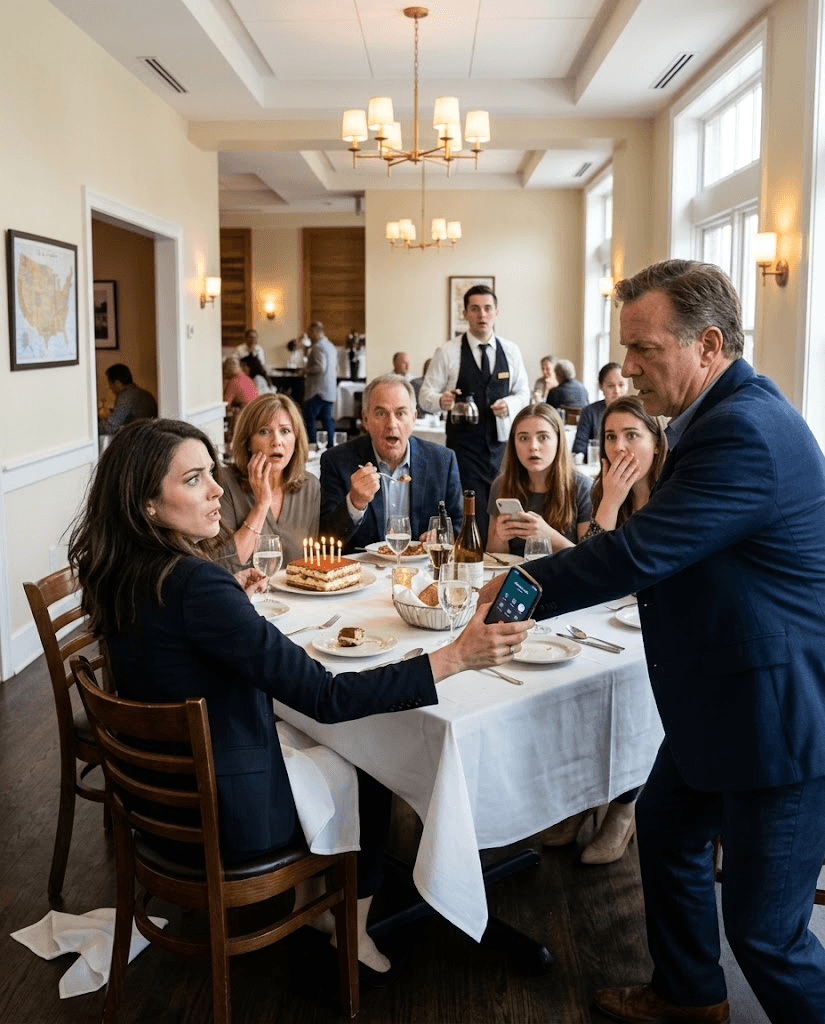
Champagne glasses froze halfway to mouths. A waiter stood beside a silver tray while one flute tilted and spilled a thin gold line across white linen. A hospital director gripped her program until it bent.
Then Julian ran.
He dropped beside me, gathered my paralyzed body into his arms, and cried with the kind of perfect grief a camera could understand.
“Someone call an ambulance!” he shouted. “Please! I told her the pressure was too much! I told her not to take anxiety medication tonight!”
There it was.
The story entering the room before I could speak.
I wanted to point at the champagne flute. I wanted to tell them to test my blood before he carried me anywhere private. I wanted to scream until every chandelier shook.
But my tongue would not move.
So I kept my eyes open.
Julian lifted me and turned toward the glass doors.
“I have private medical transport outside,” he said. “I’m not waiting while she deteriorates.”
He was not afraid I would die.
He was afraid I would be tested.
Lucas stepped into his path.
Charcoal suit. Steady shoulders. Silver badge raised high enough for the front row to see.
“Call the police too,” Lucas said. “She’s not sick.”
Julian stopped.
His arms tightened around me.
Lucas looked at the champagne flute near the piano bench, then back at my husband.
“And you are not leaving this room.”
No one spoke.
Then the photographer’s camera clicked.
That one tiny sound became the first public record of Julian’s face changing.
He tried to recover.
“This is a private medical matter.”
Lucas did not move.
“Then preserve the scene.”
A catering worker stepped forward with shaking hands. She had wrapped the champagne flute in a white napkin before anyone could step on it.
“The photographer got him handing it to her,” she whispered.
That was the second crack.
The first was the badge.
The second was a stranger deciding my silence did not make me invisible.
Police arrived six minutes later.
The first officer asked everyone to remain where they were. The second moved between Julian and the stretcher. The paramedics who reached me were not from Julian’s private transport.
Lucas gave them my name, the exposure time, and the suspected compound family.
Julian tried to interrupt.
The officer looked at him and said, “Sir, step back.”
Plain words.
Ordinary words.
After years of Julian making every room bend around him, ordinary words sounded like a door opening.
The paramedics transferred me from his arms to the stretcher.
When his hands left my body, I felt the absence like air.
Lucas leaned close.
“Emily, blink once if you can hear me.”
I blinked.
Julian said, “This is absurd.”
I blinked again.
A paramedic looked down at me and said, “She is responsive.”
Responsive meant present.
Responsive meant witness.
Responsive meant not whatever story Julian was trying to place over my body.
At the hospital, the intake desk smelled like sanitizer and burnt coffee.
A nurse placed a wristband on me and asked questions I could answer only with blinks.
Yes.
No.
Pain.
Water.
Husband not allowed.
By 11:46 p.m., my blood had been drawn, sealed, labeled, and logged.
The champagne flute was bagged separately.
The water bottle from my freezer was collected the next morning under a chain-of-custody form.
The protocol from Julian’s desk took longer because it required a warrant.
Julian’s lawyers fought it by sunrise.
Men like Julian worship paperwork right up until paperwork starts telling the truth.
The first lab report confirmed exposure to an unapproved compound related to the research Julian had been presenting that night.
Not anxiety medication.
Not misuse.
Not an accident.
The second report connected residue from the champagne flute to the same compound.
The third found related residue in the water bottle I had saved.
Julian gave a statement through counsel.
He said I was unstable.
He said Lucas was a bitter former romantic rival.
He said I had grown resentful of his work.
He said many things.
The trouble with many lies is that evidence only has to say one true thing clearly.
Lucas never tried to become the hero Julian accused him of pretending to be.
He testified when asked.
He submitted what I had sent him.
He corrected dates.
Then he sat in hospital hallways with bad vending-machine coffee and did not touch me unless I reached first.
That restraint healed something in me I had not known was injured.
My mother came on the second day.
She stood in the doorway with her purse against her chest and looked ten years older than the last photo I had of her.
“I called,” she said. “I called so many times.”
“I know,” I whispered.
She crossed the room and held my hand without asking why I stayed.
She only said, “You are coming home with me when they discharge you.”
For a while, home meant her guest room, a quilt that smelled like laundry soap, my old sheet music by the dresser, and waking at night without anyone listening outside the door.
Recovery was not graceful.
My hands shook.
My memory returned in pieces.
Sometimes a glass of water on a bedside table made me nauseous.
Sometimes applause on television made my chest tighten.
People wanted the ending to be simple because the public part had been dramatic.
Bad husband exposed.
Wife rescued.
Old love returns.
But healing is not a headline.
It is paperwork, nightmares, physical therapy, changed passwords, new locks, bank appointments, and learning that silence is not always waiting to punish you.
Months later, I walked into a courthouse hallway with my mother on one side and Lucas on the other.
Julian stood across from us in a gray suit instead of navy.
He looked smaller without a stage.
Not weak.
I will not lie about that.
He still had money, lawyers, posture, and the polished face people wanted to trust.
But the room no longer belonged to him.
When the evidence list was read, I listened to each item.
The champagne flute.
The water bottle.
The protocol file.
The event footage.
The witness statements.
The medical logs.
A marriage can hide cruelty for years, but cruelty gets careless when it believes the victim has no witness.
Julian turned once and looked at me.
I expected hatred.
I expected apology.
I got calculation.
Even then, he was still searching for the part of me he could manage.
I met his eyes and did not look away.
Afterward, people asked whether Lucas and I went back to what we had been.
We did not.
You cannot return to a life that was interrupted and pretend time waited politely beside the door.
But we began again in smaller ways.
Coffee.
Walks.
Music without an audience.
Silence that did not demand explanation.
The first time I played piano after the launch, it was in my mother’s living room on an upright that needed tuning.
My hands stumbled through the opening bars.
I cried before the second page.
No one rushed me.
No one corrected me.
No one told me my nervous system was misfiring.
Lucas stood by the window, looking out at the small American flag my mother kept near the porch rail, giving me the dignity of not being watched too closely.
I started again.
The notes were not perfect.
They were mine.
For years, Julian had turned me into a locked door.
That night at Vanguard, in front of two hundred people, Lucas did not open it for me.
He stopped Julian from carrying it away.
I had to walk through it myself.
And I did.